
During my master’s program I became obsessed with the ages of stars and how we can determine those ages. In particular I studied a method called gyrochronology which uses rotation period to infer age. Stars spin up and slow down in predictable ways throughout their lifetimes which correlates to age. Let’s get into it!
The Spin Up

Stars form from giant clouds of gas and dust that collapse under gravity. Due to the conservation of angular momentum, as that cloud shrinks it spins faster like a figure skater pulling in their arms. This means that by the time a star fully forms, it’s already rotating rapidly.
For some stars, there is a temporary braking in their youth. If a young star has a protoplanetary disc, its intense magnetic field can connect with the disc, which serves as an invisible brake to slow its rotation. However, as soon as the disc disperses-typically within a few million years-the star is able to spin up again, achieving its maximum rotational velocity. From there onwards, the only thing that can slow the rotation is time itself (and a bit of physics).
The Slow Down

A spinning top cannot spin forever-friction with the surface it’s spinning on eventually causes it to slow down and topple over. Stars have a sort of friction as well: stellar winds. As a star ages, the strong magnetic field of the star interacts with the charged particles that are streaming from its surface, ejecting them into space. But the escaping particles don’t just float away, they carry angular momentum with them which slows down the rotation period.
Gyrochronology
This ongoing, but gradual braking effect is so consistent that astronomers can use it to determine the age of a star—a technique known as gyrochronology. I conducted my PhD research primarily in the measurement of stellar rotation periods for the purpose of calibrating gyrochronology for low mass stars.
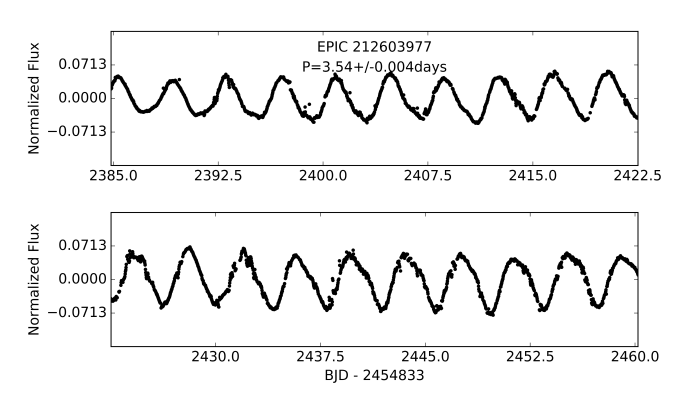
To determine a star’s rotation period, astronomers use light curves-plots of a star’s brightness over time. As a star rotates, dark star spots on its surface come in and out of view. This forms a modulation in the light curve that tells us its rotation period, as seen in the figure above. We can use the modulation of the light curve to measure a star’s rotation period.
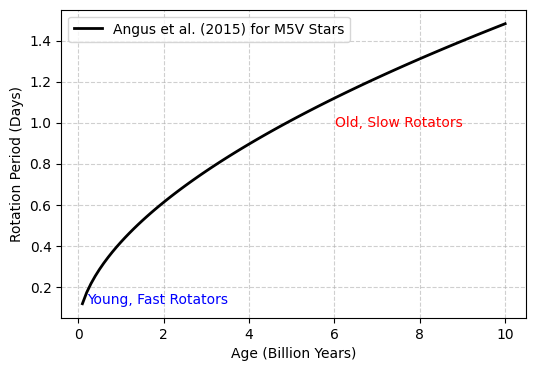
By plotting out the relationship between rotation period and age, we can see how stars are expected to slow down over time. The gyrochronology curve I generated using the Angus et al. (2015) model shows this trend-young stars spin rapidly, while older stars have slower rotations.
But not all stars follow this rule. Some fast rotators defy expectations and rotate too fast for their age. These old, fast rotators were a surprise in my data set that turned into a fun side project during my time at Georgia State.
Don’t forget to subscribe below, so you’re alerted to my new posts. Thanks for reading!

Dicy Adams holds Bachelor’s Master’s and Doctoral degrees in Physics & Astronomy. She is an astronomer turned data scientist turned aspiring high school educator.

 Astro Dicy
Leave a comment